
RTX 3070 in 2026: Is It Still Good for 1440p Gaming?
XGW examines where NVIDIA's RTX 3070 still fits for 1440p gaming in 2026, where its 8GB VRAM can become a limitation, and who should consider upgrading.
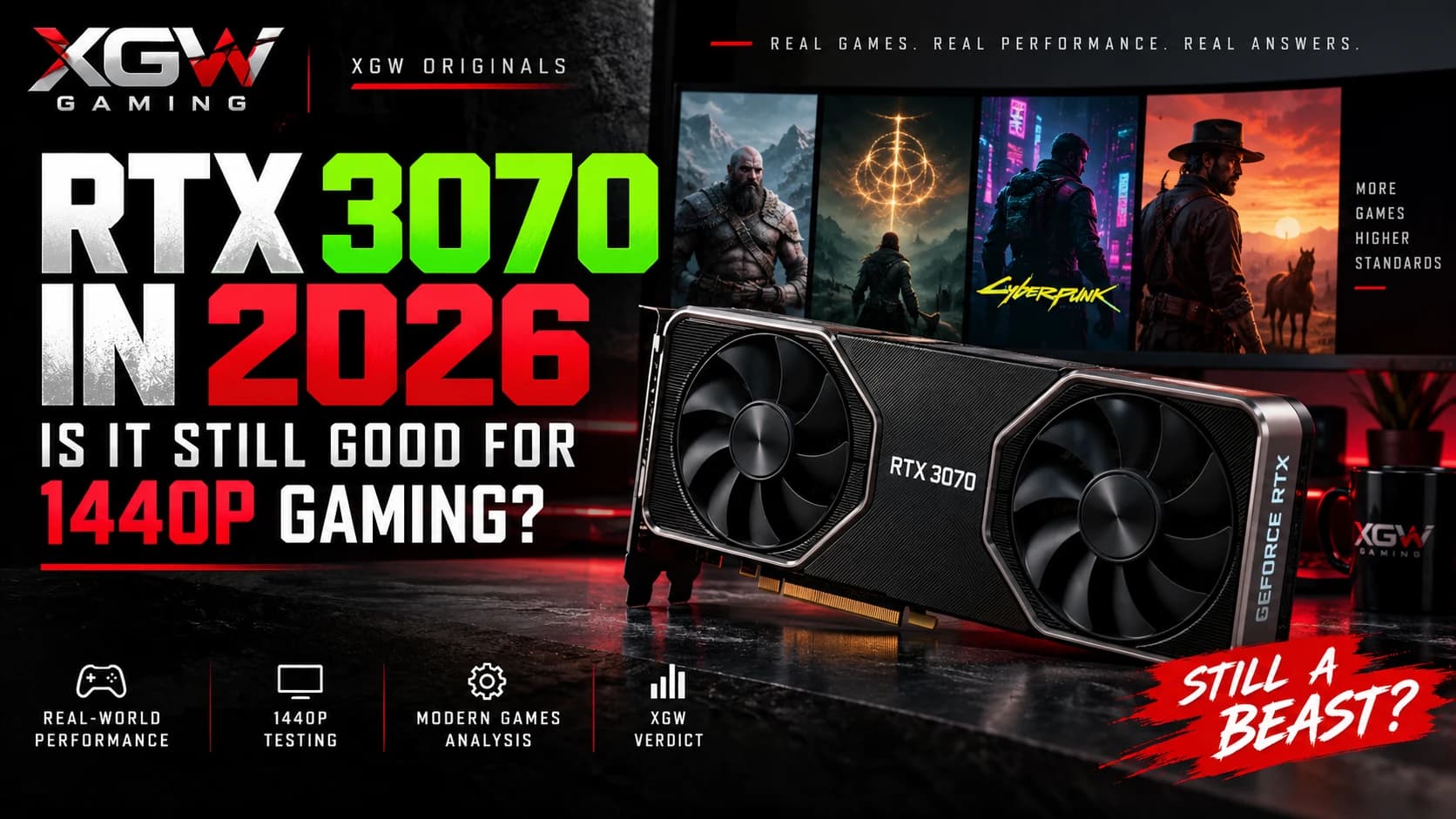
The GeForce RTX 3070 is no longer a new graphics card, but that does not automatically make it obsolete. For players targeting 1440p, the more useful question in 2026 is not whether the card can still run modern games, but where compromises now begin to appear.
This XGW feature looks at the RTX 3070 as a current 1440p gaming option: the areas where it still makes sense, the situations where its 8GB of VRAM can become restrictive, and the upgrade scenarios that are actually worth considering.
XGW Brief
Key Findings
- The RTX 3070 can still make sense for 1440p gaming when settings are chosen intelligently rather than simply maxed out.
- Its 8GB VRAM capacity is now the most important long-term limitation to watch in demanding modern titles.
- Upscaling technologies can extend the useful life of the GPU when raw native-resolution performance is not enough.
- Players who already own an RTX 3070 have a different decision than someone buying one today: an upgrade should deliver a clearly meaningful jump, not a small generational improvement.
- This article is an editorial hardware assessment; XGW's measured game-by-game benchmark table can be added after a controlled benchmark pass on the test system.
Why the RTX 3070 still matters
The RTX 3070 was positioned as a strong high-refresh 1440p GPU, and that basic capability has not disappeared. Its core rendering performance is still sufficient for a broad range of competitive games, older AAA releases and many newer titles when settings are balanced around image quality rather than maximum presets.
That distinction matters. Ultra presets often impose disproportionately large performance and memory costs for relatively small visual gains. A card that struggles with every option maxed out can still deliver an excellent 1440p experience after a few expensive settings are reduced.
The 8GB VRAM question
The RTX 3070's 8GB framebuffer is the part of the card that has aged less gracefully than its raw GPU performance. Modern games can allocate large amounts of video memory for high-resolution textures, ray-traced effects and dense world data, especially at higher presets.
Running out of comfortable VRAM headroom does not always show up as a simple lower average frame rate. It can appear as inconsistent frame pacing, texture-streaming issues or sudden drops in demanding scenes. That is why texture quality and ray-tracing settings deserve special attention on an 8GB card.
1440p settings matter more than the preset label
For an RTX 3070 owner, the strongest 1440p strategy in 2026 is usually a customized High preset rather than blindly choosing Ultra. Texture quality should be set according to memory behaviour in the specific game, while expensive effects such as heavy ray tracing, volumetrics and extreme shadow settings can often be reduced with a smaller visual penalty.
This approach keeps the GPU focused on the parts of the image that make the biggest difference while avoiding settings that consume a large amount of performance for limited real-world improvement.
DLSS can extend the card's useful life
Upscaling remains one of the RTX 3070's most useful tools. At 1440p, a well-implemented quality-mode upscaler can reduce rendering cost while preserving a strong image, making it easier to maintain smoother performance in demanding games.
Upscaling is not a substitute for unlimited VRAM, and it cannot fix every bottleneck, but it can significantly change whether a game feels comfortable on the card. For owners who are satisfied with image quality using DLSS, the RTX 3070 can remain practical for longer than native-resolution-only comparisons suggest.
Ray tracing is now the harder compromise
Ray tracing places additional pressure on both performance and memory. The RTX 3070 can still use ray-traced effects, but newer games increasingly make full or high-end ray tracing the point where compromises become obvious.
For many 1440p players, the better balance is conventional rasterized lighting at higher frame rates, or selective ray-traced effects paired with upscaling. The card is much easier to recommend when ray tracing is treated as optional rather than mandatory.
Should an existing RTX 3070 owner upgrade?
An existing owner should focus on the size of the improvement rather than the age of the card. If the games you play still meet your frame-rate and image-quality targets, replacing the GPU simply because it is several generations old offers little practical value.
An upgrade becomes easier to justify if you regularly hit VRAM limitations, want much stronger ray tracing, are moving to higher-resolution or high-refresh displays, or need enough performance headroom to avoid aggressive upscaling and settings reductions in newer AAA games.
Buying an RTX 3070 in 2026 is a different decision
The second-hand price changes the equation. A very inexpensive RTX 3070 can still be attractive for a budget 1440p build, but buyers should compare it with newer cards that offer more VRAM, newer media features, better efficiency or newer frame-generation support.
The correct comparison is therefore not whether the RTX 3070 was a good GPU when it launched. It is whether its current price compensates for the limitations of an older 8GB design.
Testing & Methodology
How XGW Evaluates It
This first version is an XGW editorial hardware assessment rather than a published benchmark report.
No synthetic or game FPS numbers have been invented for this article.
When XGW adds measured results, the benchmark section should identify the CPU, RAM, driver version, game version, graphics settings, resolution, upscaling mode and the measurement method used.
Measured benchmark data should be kept separate from estimates or manufacturer claims.
Strengths
Pros
- +Still capable of strong 1440p gaming with sensible settings.
- +DLSS support helps extend usable performance in demanding games.
- +Existing owners may not need to upgrade if current games already meet their targets.
Limitations
Cons
- −8GB VRAM can be restrictive in demanding modern titles.
- −High-end ray tracing is increasingly difficult without meaningful compromises.
- −A used purchase only makes sense when priced well against newer alternatives.
XGW Original Analysis
XGW Verdict
The RTX 3070 is still a viable 1440p GPU in 2026, but it is no longer a card that can be treated as an automatic max-settings option. Existing owners can continue using it effectively by managing VRAM-heavy settings and leaning on DLSS when needed. For new buyers, price is everything: the card only makes sense when the discount is large enough to offset its 8GB memory ceiling and older feature set.
Keep Reading
Related Features


XGW Originals
In-depth gaming features, hardware analysis, comparisons, benchmarks and original XGW perspectives.
← Back To Features