
Ryzen 7 5800X + RTX 3070 in 2026: Is This AM4 Gaming PC Still Good?
XGW evaluates the Ryzen 7 5800X and RTX 3070 combination in 2026, including CPU longevity, 1440p balance, VRAM limitations and whether an AM4 owner actually needs to upgrade.
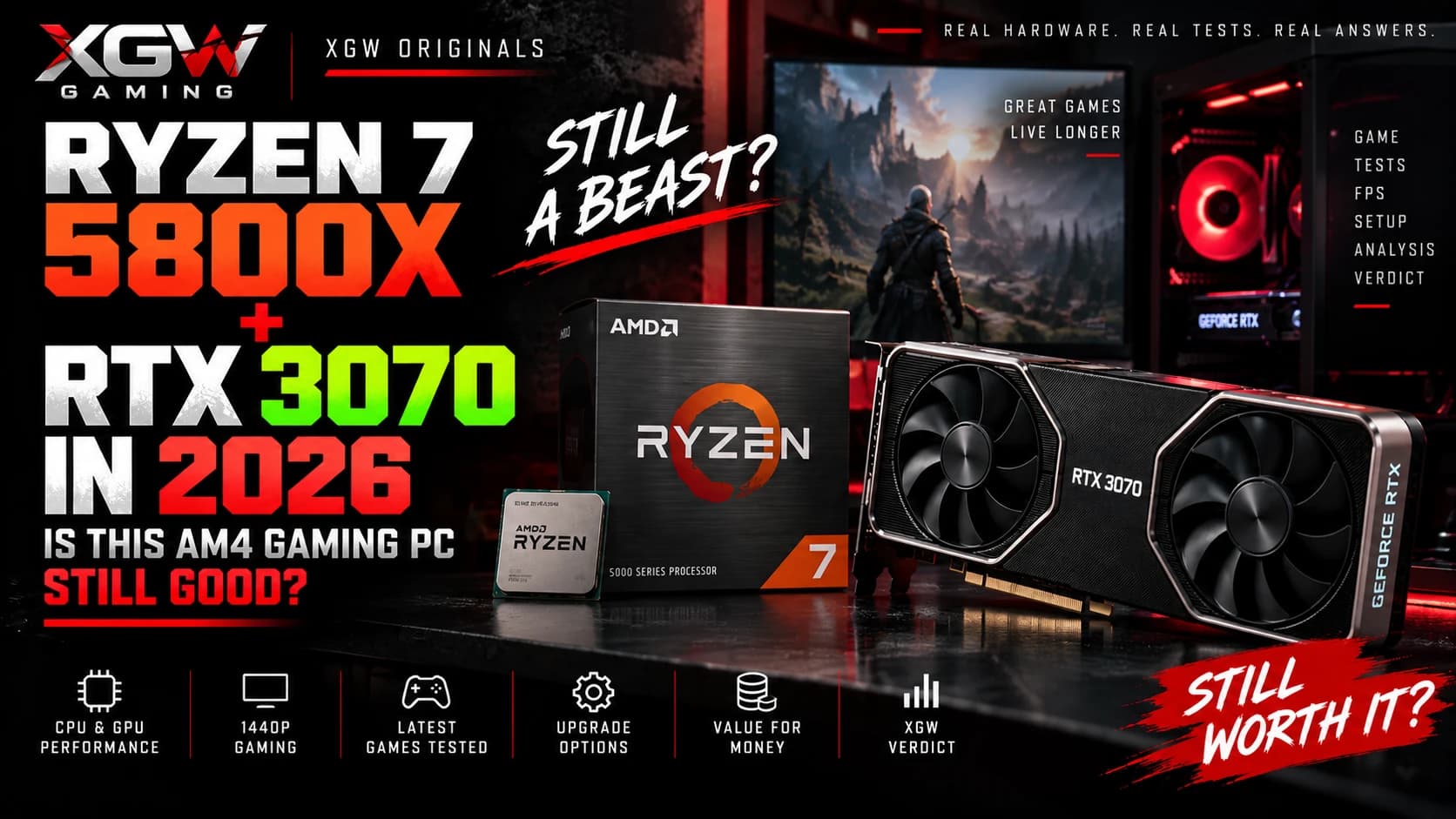
A Ryzen 7 5800X paired with a GeForce RTX 3070 represents a very different upgrade question in 2026 than it did when both components were new. The processor still offers eight Zen 3 cores and 16 threads, while the RTX 3070 remains capable at 1440p but carries an increasingly important 8GB VRAM limitation.
For an existing AM4 owner, the useful question is not whether newer hardware is faster. It obviously is. The question is whether the current system is actually preventing you from reaching the frame rate, image quality or workflow targets that matter to you.
XGW Brief
Key Findings
- The Ryzen 7 5800X remains a capable eight-core, 16-thread AM4 processor for gaming and general creator workloads.
- At 1440p, the RTX 3070 will often become the more relevant constraint before the 5800X in graphically demanding games.
- The RTX 3070's 8GB GDDR6 memory is a more significant 2026 limitation than the CPU's core count.
- Existing owners should prioritize a GPU upgrade when modern AAA performance or VRAM is the problem rather than replacing the entire platform automatically.
- XGW will add measured FPS and frame-time results only after a controlled benchmark pass; no benchmark numbers are fabricated here.
What the Ryzen 7 5800X still offers
AMD lists the Ryzen 7 5800X as an eight-core, 16-thread Zen 3 desktop processor with a 3.8GHz base clock, boost frequency up to 4.7GHz, 32MB of L3 cache and a 105W default TDP. It uses the AM4 socket, DDR4 memory and PCIe 4.0.
Those specifications do not make it a modern flagship, but they remain a solid foundation for a gaming PC. For players already on AM4, retaining the CPU can preserve motherboard and memory investment while directing upgrade money toward the component that produces the largest visible gain.
Why 1440p changes the balance
As resolution and visual settings rise, the graphics card usually carries more of the rendering workload. That makes a 5800X and RTX 3070 pairing easier to justify at 1440p than in scenarios built around extremely high competitive frame rates at lower resolutions.
In demanding AAA games, reducing GPU-heavy settings or using a quality upscaling mode can therefore have a larger effect than replacing an already capable eight-core CPU.
The RTX 3070 is the part to watch
NVIDIA specifies the RTX 3070 with 5,888 CUDA cores, an Ampere GPU, a boost clock of 1.73GHz and 8GB of GDDR6 on a 256-bit memory interface. It also supports DLSS, Reflex and second-generation ray-tracing cores.
Raw rendering capability remains useful, but the 8GB framebuffer can become restrictive when newer games combine high-resolution textures, heavy ray tracing and large environments. That makes memory behaviour one of the first things an existing owner should examine before blaming the whole PC.
When a CPU upgrade actually makes sense
A platform upgrade becomes more compelling when the target is very high refresh-rate gaming, when CPU-heavy games repeatedly limit the GPU, or when the system is also being used for workloads that benefit materially from newer CPU architectures and platform features.
If the machine is primarily a 1440p gaming system and the GPU is already operating near full load, replacing the motherboard, CPU and memory may deliver less visible improvement than investing that budget into a substantially faster graphics card.
Upgrade the bottleneck, not the calendar
Hardware age by itself is not a useful upgrade metric. Frame-rate targets, frame-time consistency, VRAM pressure, display resolution, ray-tracing expectations and creator workloads provide much better reasons to spend money.
For an existing 5800X and RTX 3070 owner, the sensible 2026 strategy is to measure the games and workloads that actually matter, identify the limiting component and only then choose the next upgrade.
Testing & Methodology
How XGW Evaluates It
Specifications in this article are checked against AMD and NVIDIA product documentation.
This article does not claim unpublished XGW FPS results.
A future XGW benchmark revision should record CPU and GPU clocks, RAM configuration, driver version, game build, resolution, preset, ray tracing, upscaling mode, average FPS and low-percentile/frame-time data.
Strengths
Pros
- +Eight Zen 3 cores and 16 threads remain useful for a broad gaming workload.
- +Well-balanced pairing for many 1440p scenarios.
- +Existing AM4 owners can avoid a full-platform replacement when the GPU is the real bottleneck.
Limitations
Cons
- −RTX 3070 8GB VRAM can constrain newer AAA settings.
- −The AM4/DDR4 platform has less forward upgrade headroom than current platforms.
- −Very high-refresh CPU-limited gaming can expose the age of the 5800X.
XGW Original Analysis
XGW Verdict
The Ryzen 7 5800X and RTX 3070 remain a credible 1440p combination in 2026 for an owner who is willing to tune demanding games. The GPU's 8GB VRAM is the more obvious pressure point. Unless real testing shows a CPU bottleneck in the games you actually play, a meaningful GPU upgrade is likely to be the first place to look.
Keep Reading
Related Features


XGW Originals
In-depth gaming features, hardware analysis, comparisons, benchmarks and original XGW perspectives.
← Back To Features